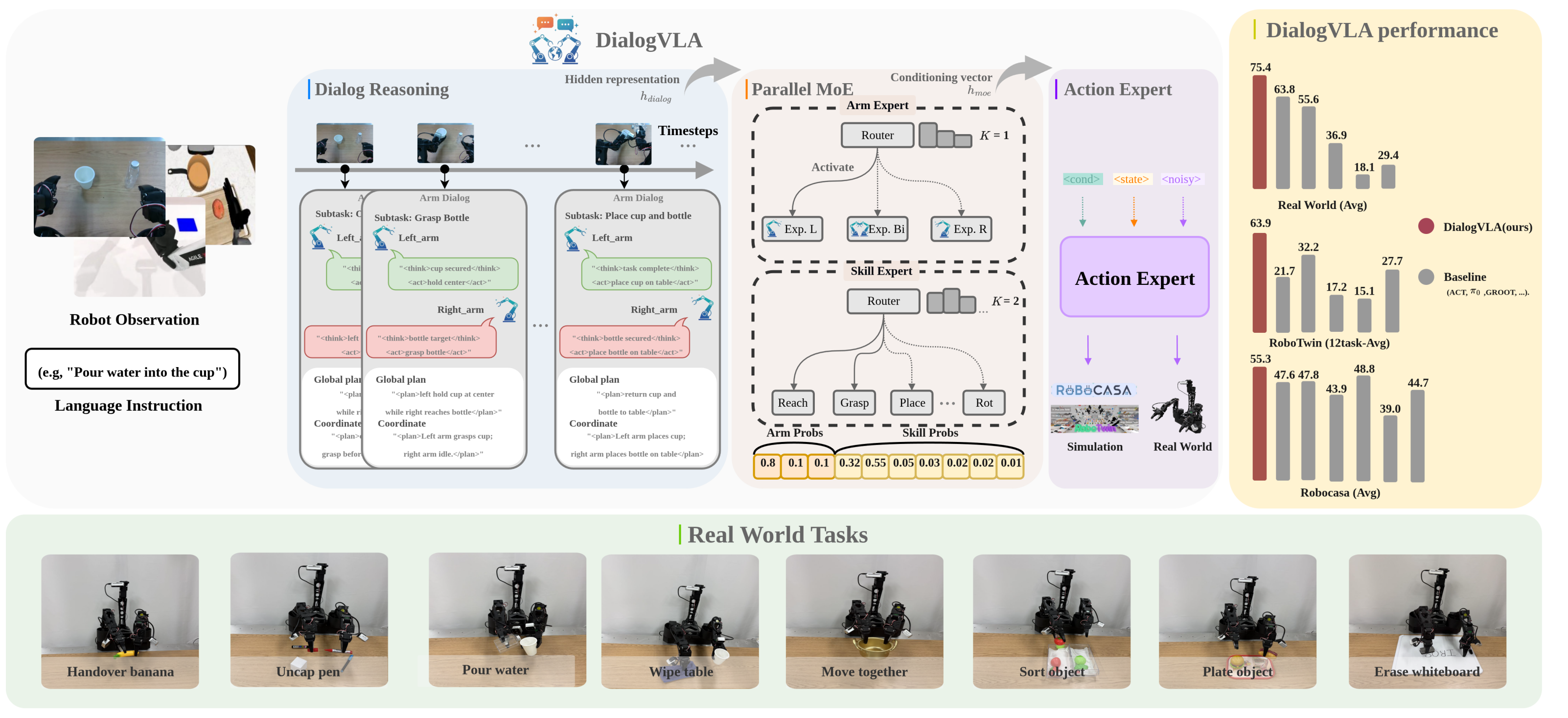
Vision-Language-Action (VLA) models show strong generalization for instruction-based manipulation, yet in bimanual settings two challenges remain: misalignment between high-level decision-making and low-level action generation, and uncertainty in arm-role assignment. Existing methods implicitly project manipulation stages and arm-leadership decisions into a single action space, which fails to secure structural control stability in complex collaborative situations.
We propose DialogVLA, which explicitly reasons about manipulation stages and arm roles through Dialog Reasoning, and binds high-level reasoning to continuous control by conditioning it on MoE-based structural routing and a Flow Matching Action Expert. A Two-Stage training strategy separates reasoning/routing from action generation to improve stability and generalization.
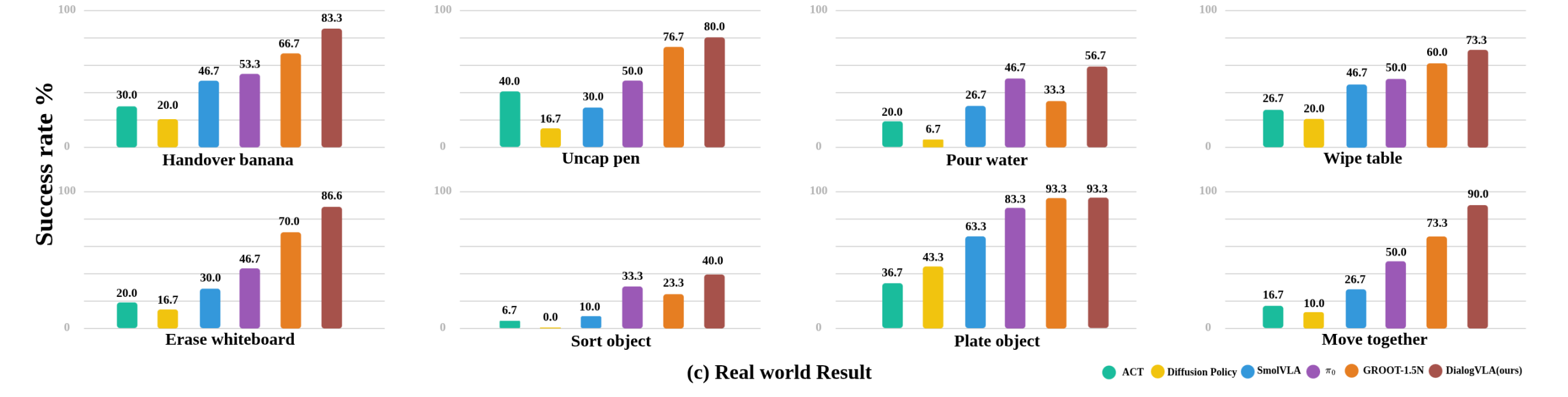
On RoboCasa and RoboTwin benchmarks and in real-robot experiments, DialogVLA consistently outperforms prior robot-learning and VLA baselines — reaching 82.8% / 63.9% average success on RoboTwin Easy / Hard, and 75.4% on real-world bimanual collaborative tasks.
A structural VLA framework that explicitly decomposes Skill Phase and Arm Role for bimanual manipulation.
A design that models collaborative states by configuring Skill MoE and Arm MoE in parallel, delivering them directly as conditioning signals to action generation.
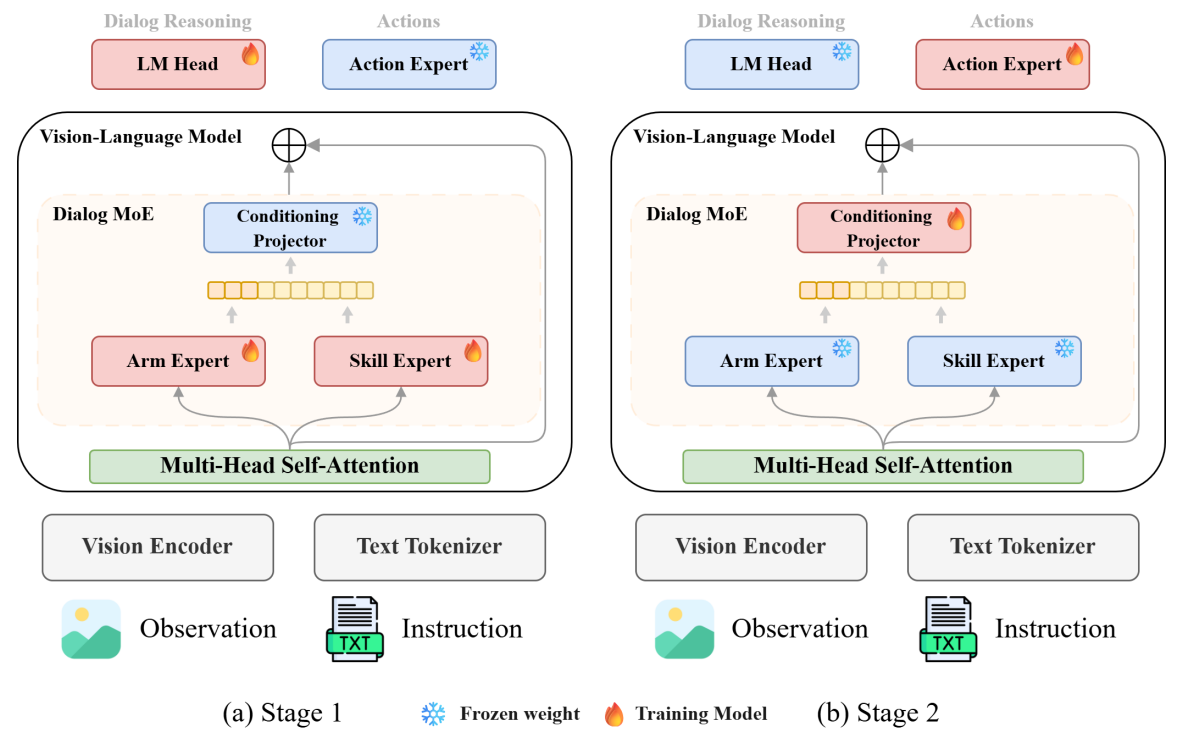
A Two-Stage Training strategy that separates reasoning/routing learning from action-generation learning, validated in both simulation and real-robot environments.
Three ways to get from reasoning to action. The first hides the decision; the second exposes it but breaks the gradient. DialogVLA keeps one model and carries the decision forward as a continuous signal.
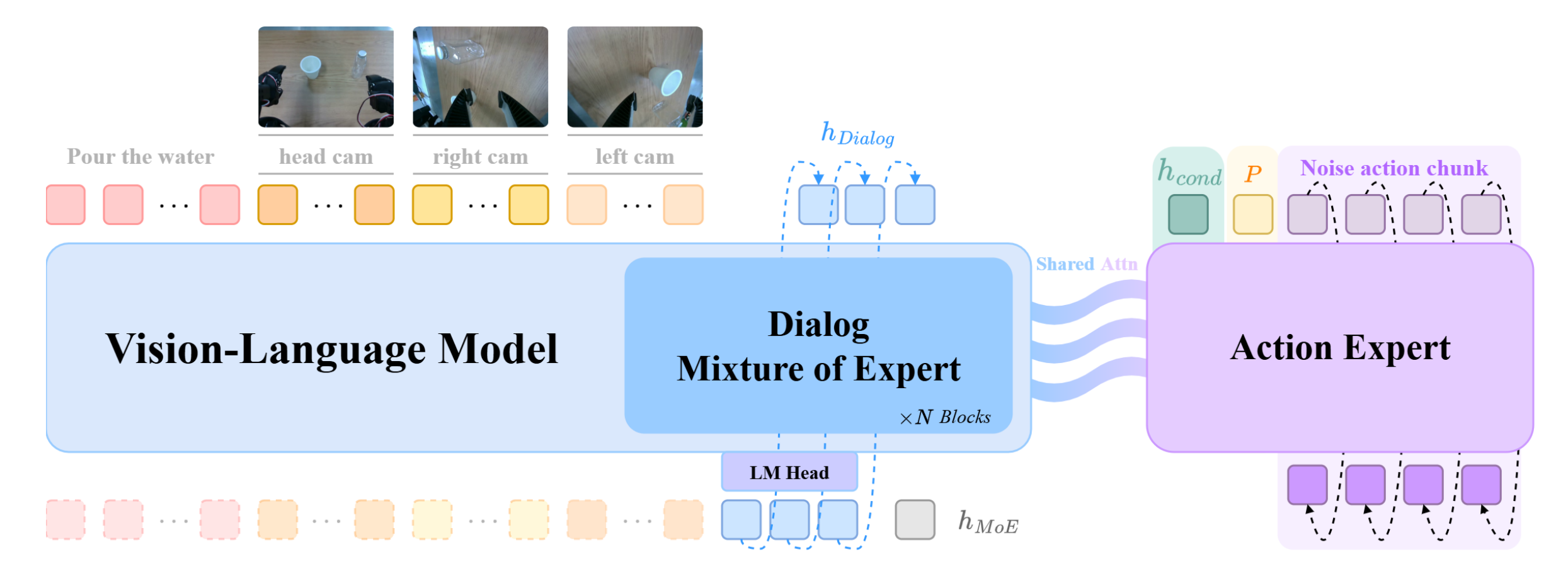
From the head-view image and the instruction, the VLM autoregressively emits a structured dialog that names the current Skill Phase and assigns a role to each arm — making the decision explicit instead of burying it in the action vector.
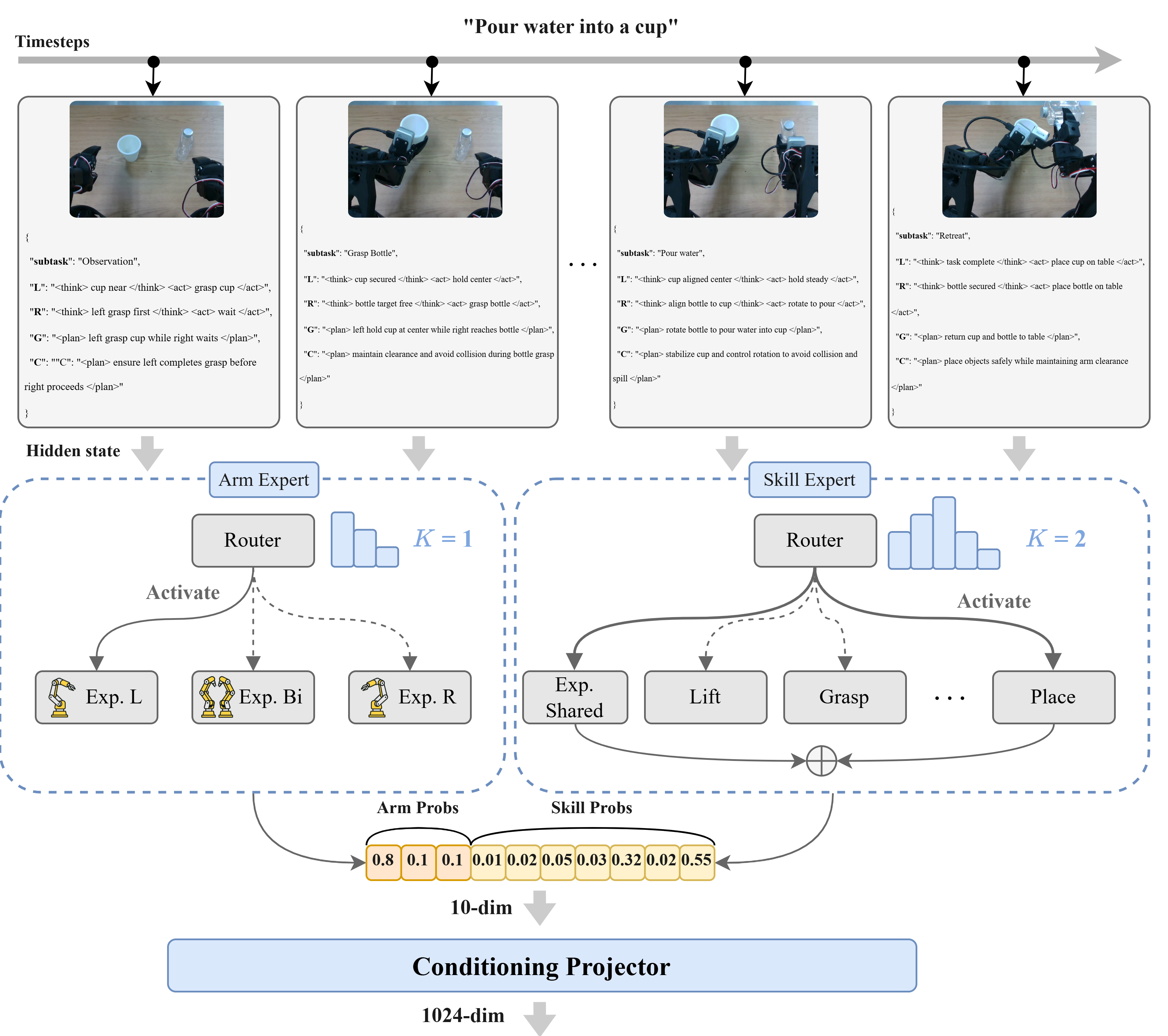
Every FFN in the backbone becomes two expert groups. A Skill Router picks the top-2 of 7 phase experts; an Arm Router picks 1 of 3 role experts. Their probabilities form a 10-dim conditioning vector.
The projected routing vector modulates the Flow Matching Action Expert through AdaRMS, so the velocity field it generates matches the current phase and arm role — even under identical visual input.

Bottle to cabinet close
Can to drawer close
Cuttingboard to basket
Cuttingboard to pan
Placemat to basket
Placemat to bowl
Tray to cardboard box
Tray to plate
| Task (Avg) | Isaac-GR00T | QwenGR00T | QwenPI | QwenOFT | QwenFAST | VisionOnly | DialogVLA (Ours) |
|---|---|---|---|---|---|---|---|
| PnP * to * Close (Avg) | 24.2 | 50.3 | 42.3 | 43.7 | 35.0 | 54.0 | 44.6 |
| PnP Novel From Cuttingboard To * (Avg) | 56.9 | 52.8 | 46.0 | 50.4 | 50.4 | 45.2 | 57.6 |
| PnP Novel From Placemat To * (Avg) | 51.9 | 38.0 | 43.5 | 41.5 | 33.5 | 32.5 | 53.5 |
| PnP Novel From Tray To * (Avg) | 55.1 | 39.2 | 44.0 | 49.2 | 32.0 | 44.8 | 64.0 |
| PnP Novel From Plate To * (Avg) | 57.6 | 58.5 | 44.0 | 61.0 | 45.0 | 42.0 | 56.8 |
| Overall Average | 47.6 | 47.8 | 43.9 | 48.8 | 39.0 | 44.7 | 55.3 |
Easy Scenario
Dump bin bigbin
Handover block
Grab roller
Pick dual bottles
Hard Scenario
Dump bin bigbin
Handover block
Grab roller
Pick dual bottles
| Task | ACT | π0 | RDT | DialogVLA (Ours) | ||||
|---|---|---|---|---|---|---|---|---|
| Easy | Hard | Easy | Hard | Easy | Hard | Easy | Hard | |
| Dump Bin Bigbin | 68.0 | 1.0 | 83.0 | 24.0 | 64.0 | 32.0 | 94.0 | 55.0 |
| Grab Roller | 94.0 | 25.0 | 96.0 | 80.0 | 74.0 | 43.0 | 98.0 | 83.0 |
| Handover Block | 42.0 | 0.0 | 45.0 | 8.0 | 45.0 | 14.0 | 88.0 | 67.0 |
| Lift Pot | 88.0 | 0.0 | 84.0 | 36.0 | 72.0 | 9.0 | 92.0 | 59.0 |
| Pick Dual Bottles | 31.0 | 0.0 | 57.0 | 12.0 | 42.0 | 13.0 | 82.0 | 63.0 |
| Place Bread Skillet | 7.0 | 0.0 | 23.0 | 1.0 | 5.0 | 1.0 | 91.0 | 77.0 |
| Place Cans Plasticbox | 16.0 | 0.0 | 34.0 | 2.0 | 6.0 | 5.0 | 57.0 | 18.0 |
| Place Dual Shoes | 9.0 | 0.0 | 15.0 | 0.0 | 4.0 | 4.0 | 77.0 | 63.0 |
| Put Object Cabinet | 15.0 | 0.0 | 68.0 | 18.0 | 33.0 | 18.0 | 66.0 | 67.0 |
| Scan Object | 2.0 | 0.0 | 18.0 | 1.0 | 4.0 | 1.0 | 72.0 | 54.0 |
| Stack Blocks Three | 0.0 | 0.0 | 17.0 | 0.0 | 2.0 | 0.0 | 86.0 | 82.0 |
| Stack Bowls Three | 48.0 | 0.0 | 66.0 | 24.0 | 51.0 | 17.0 | 91.0 | 79.0 |
| Overall Average | 34.5 | 2.2 | 50.5 | 17.2 | 33.5 | 13.1 | 82.8 | 63.9 |
Each task is evaluated with 100 rollouts on the 14-DoF ALOHA-AgileX embodiment.
Evaluated on the SO-ARM 101 platform (head + left/right wrist cameras) across 8 bimanual collaborative tasks. DialogVLA reaches 75.4% average success, outperforming ACT, Diffusion Policy, SmolVLA, π0, and GR00T-1.5N on every task.
Handover banana
“handover the banana”
Uncap pen
“Remove the pen cap”
Pour water
“Pour water into the cup”
Wipe table
“Wipe the surface, lifting the obstacle if necessary”
Erase whiteboard
“Erase the text on the whiteboard”
Sort object
“sort items by color”
Plate object
“Place a hamburger and hotdog neatly on a tray for serving”
Move together
“Perform a coordinated transport of the heavy object”
| Method | Handover | Move | Avg |
|---|---|---|---|
| w/o MoE Conditioning | 65.0 | 45.0 | 55.0 |
| w/o Arm Expert | 70.0 | 55.0 | 62.5 |
| w/o Skill Expert | 70.0 | 65.0 | 67.5 |
| w/o Stage 1 | 55.0 | 35.0 | 45.0 |
| DialogVLA (Full) | 85.0 | 90.0 | 87.5 |
@article{choi2026dialogvla,
  title   = {DialogVLA: Bridging Reasoning Action in Bimanual Manipulation via Parallel Mixture-of-Experts},
  author  = {Jeonghwan Choi, Hyunwoo  Kim, Ilsung Jin and Donghan Kim},
  booktitle = {IEEE/RSJ International Conference on Intelligent Robots and Systems (IROS)},
  year    = {2026}
}